Up to 4 Second Print
UV laser etches text, symbols, and barcodes onto slides in up to 4 seconds per slide, depending on print content and laser settings. No ribbon changes or warm-up delays.
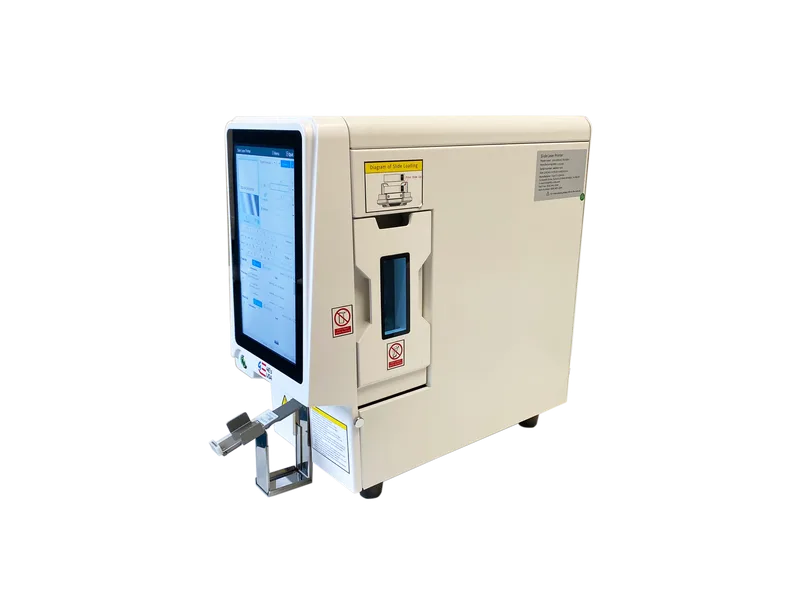
Model UVP202001 · Slide UV Printer — Single Hopper
UV laser direct-on-glass · no ink · no ribbons · 10-inch touchscreen · text + barcodes + QR
Key Specifications
Slide labels need to be evaluated against the lab's actual slide stock, staining workflow, scanner setup, and archive requirements. Ink, ribbon, adhesive, and handwritten workflows can all introduce durability, consumable, or legibility questions that should be tested before routine use.
UV laser printing marks information directly on the slide surface. The IFU describes the marking as resistant to corrosion, heat, and low temperature, and suitable for long-term storage. No ink cartridges or ribbons are required for routine printing. An external filter module may need periodic replacement — typically every 10,000–30,000 prints.
For histology, pathology, cytology, and research workflows, the UVP202001 supports stand-alone touchscreen operation, barcode scanner input, and networked remote print workflows — including synchronous printing from the UVP202002 tissue cassette printer over LAN.
Watch Four E's demonstrate UV microscope slide printing — direct-on-glass laser marking, hopper loading, and bench workflow.
Up to 4 Second Print
UV laser etches text, symbols, and barcodes onto slides in up to 4 seconds per slide, depending on print content and laser settings. No ribbon changes or warm-up delays.
No Ink or Ribbons
Routine slide marking uses UV laser ablation rather than ink or ribbon printing. External filter maintenance may apply; recommended replacement every 10,000–30,000 prints.
Durable Slide Marking
UV laser ablation marks compatible microscope slides for clear, durable identification. The user manual describes corrosion-, heat-, and low-temperature-resistant marking suitable for long-term storage.
Stand-alone & Networked
Stand-alone touchscreen operation plus serial, LAN, remote print software, and TXT-folder monitoring for networked print workflows.
Priority 01
Histology and Pathology
Challenge: Reliable slide identification through staining and archive storage.
Value: Microscope slide identification for routine histology and diagnostic pathology workflows, tissue archive tracking, and specimen chain-of-custody documentation.
Priority 02
Clinical Diagnostic Labs
Challenge: High-volume slide labeling with traceable, scannable records.
Value: High-volume diagnostic slide labeling with barcode-scannable slide records and networked print workflows.
Priority 03
Research Labs
Challenge: Durable slide IDs across long studies and harsh staining workflows.
Value: Research slide labeling where consistent, durable identification is required across long study periods, multi-year archives, or demanding staining workflows.
The UVP202001 ships ready for bench use — single-hopper design optimized for single-slide-type workflows.
Designed for fast technical review. Final compliance and warranty wording remains marked until approved documentation is published.
| Model / SKU | UVP202001 |
|---|---|
| Configuration | Single Hopper |
| Print Technology | UV Laser — direct on glass |
| Consumables | No ink or ribbons; external filter maintenance may apply |
| Print Speed | Up to 4 seconds per slide |
| Slide Size | 75–76 mm × 25–26 mm × 0.9–1.2 mm |
| Print Area | 23 mm × 18–30 mm adjustable |
| Input Capacity | 100 slides |
| Output Capacity | 20 slides (FILO) |
| Print Capabilities | Text · Symbols · 1D codes · QR codes |
| Display | 10-inch color touchscreen |
| Stand-alone Operation | Yes |
| LIS/LIMS Workflows | Serial, LAN, remote print software, TXT-folder monitoring |
| Cassette Printer Sync | Yes — synchronous printing from UVP202002 over LAN |
| Label Durability | Corrosion-, heat-, and low-temperature-resistant (per IFU) |
| Filter Maintenance | Replaceable external filter — every 10,000–30,000 prints |
| Dimensions (W × D × H) | 437 × 200 × 445 mm |
| Net Weight | ≤24 kg |
| Power | 240 W |
| Input Voltage / Frequency | AC 100–240V, 50/60 Hz |
| Operating Temperature | 10–30°C (10–28°C recommended) |
| Max Relative Humidity | ≤70%, non-condensing |
| Noise | 50 dB |
Share the model, volume, and purchase timeline for your purchase inquiry.
Answers focused on practical buying and implementation questions from lab managers, scientists, and startup founders.
The best fit depends on slide stock, daily volume, LIS/LIMS integration, and hopper needs. Compare evaluation criteria in the best slide printer for pathology labs buying guide, then review UVP202001 single-hopper and UVP202001D dual-hopper options against your workflow.
The UVP202001 supports serial, LAN, remote print software, and TXT-folder monitoring so accession fields reach slide templates without retyping. Field mapping, separator symbols, and barcode validation should be confirmed before go-live.
The UVP202001 is ideal when your lab runs one primary slide type and does not need to switch slide stocks mid-batch.
The user manual specifies slides measuring 75–76 mm × 25–26 mm × 0.9–1.2 mm, with an adjustable print area of 23 mm × 18–30 mm.
The user manual lists print speed as up to 4 seconds per slide, depending on print content, laser parameters, and other factors.
No. The UVP202001 uses UV laser marking rather than ink or ribbon printing. The external filter module has a replaceable filter, recommended every 10,000–30,000 prints.
Yes. The user manual describes serial, LAN/network, remote printing software, and TXT-folder-based remote print workflows that can receive print tasks from a histology LIS or pathology system.
Yes. The UVP202002 cassette printer can connect to the UVP202001 for linked cassette-and-slide specimen tracking workflows, including synchronous printing over LAN.
The vendor lists a manufacturer's warranty. Confirm current warranty and service terms with your supplier when making a purchase inquiry.
Continue evaluating workflow fit, model specs, and integration requirements.
Warranty
The UVP202001 includes manufacturer warranty coverage per vendor documentation. Confirm warranty terms when making a purchase inquiry.